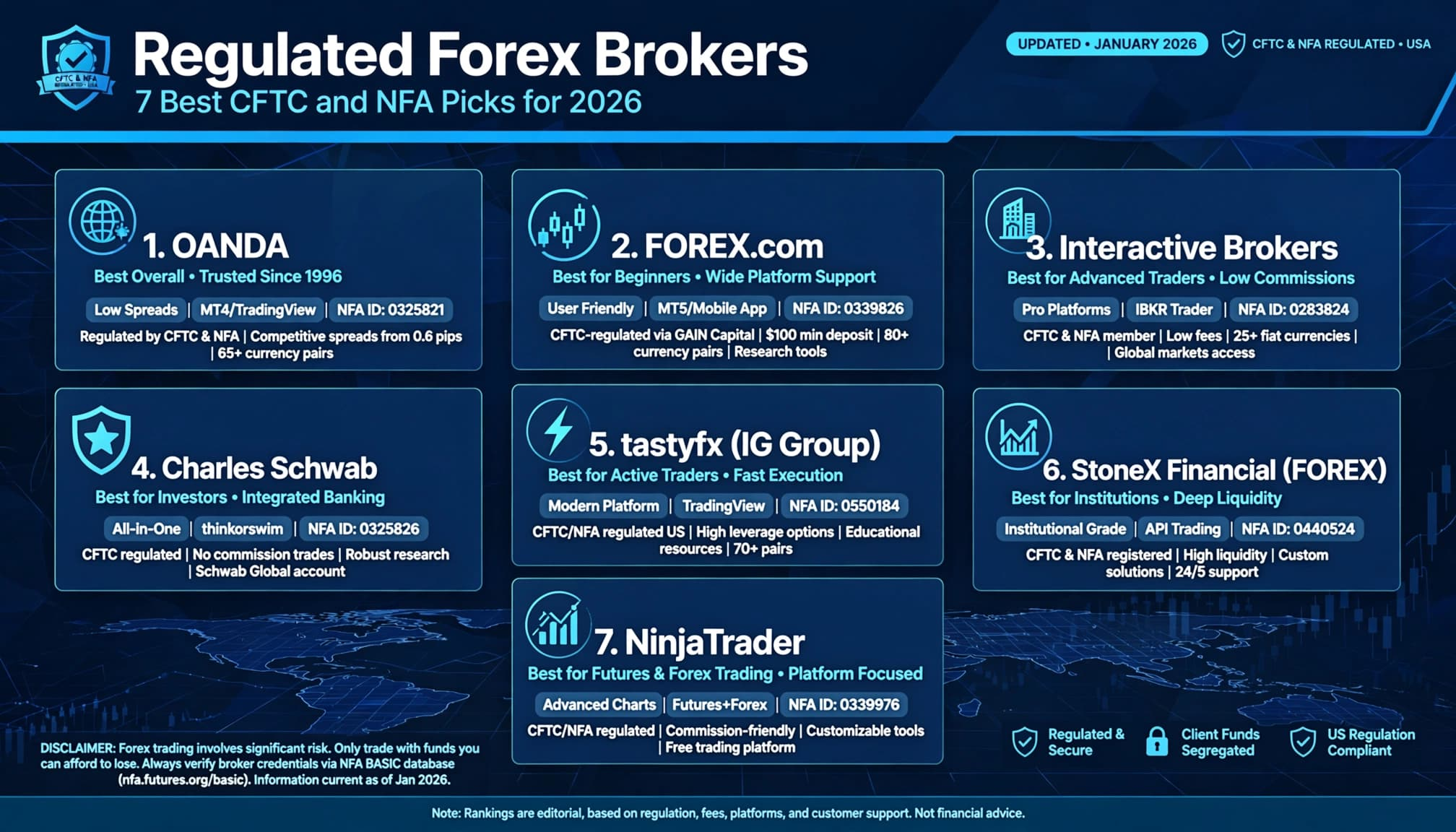
For US traders, a regulated forex broker must be registered with the CFTC as a Retail Foreign Exchange Dealer (or futures commission merchant) and belong to the NFA, which anyone can verify in the free BASIC database by searching the legal entity name.
The article reviews seven US-facing options for 2027: tastyfx, FOREX.com, OANDA, Charles Schwab, Interactive Brokers, Trading.com, and Plus500 US, which offers currency futures rather than spot forex. Each review covers registration, platforms, costs, ideal users, and drawbacks. It explains US rules such as 50:1 leverage on majors, FIFO order handling, no hedging, and tax treatment under Section 988 versus Section 1256.
Foreign licenses like FCA or CySEC do not protect US clients, and offshore brokers advertising 1:500 leverage or bonuses offer no NFA arbitration, capital requirements, or recourse. The article gives a five-step verification process, red flags, and a safe account-opening routine: demo first, small deposit, early test withdrawal, and 1% to 2% risk per trade. It concludes that verification matters more than bonuses or leverage.
Picking a regulated broker forex traders can trust is harder than it looks. Many sites rank brokers by bonuses alone, and plenty of offshore firms accept US clients without any real oversight. If you trade from the United States, that gap can cost you your whole deposit.
Here is the direct answer. For US residents, a regulated forex broker must be registered with the CFTC as a Retail Foreign Exchange Dealer and be a member of the NFA. You can confirm this in minutes on the NFA’s BASIC database. Leverage is capped at 1:50 on majors, so ignore any broker promising 1:500 to US accounts.
Below, you will find the 7 Regulated best forex brokers for 2027 that meet this standard. For each one, we cover regulation, minimum deposit, spreads, platforms such as MT4, and who it suits. At FXNDB we review brokers daily and focus on regulation first, bonuses second, so you can compare options and open a live account with confidence.
1. Quick comparison of the best regulated forex brokers
Side-by-side snapshot
Every broker below is a US-facing firm that holds CFTC and NFA status, so each counts as a regulated forex broker for American residents. Use the table to shortlist two or three, then read the full reviews. These are the best forex brokers for traders who put safety ahead of headline leverage.
| Broker | US registration | Platform highlight | Best for |
|---|---|---|---|
| tastyfx | RFED, NFA member | Proprietary web and mobile | Active retail traders |
| FOREX.com | RFED, NFA member | MT5, TradingView, proprietary | Platform choice |
| OANDA | RFED, NFA member | OANDA Trade, MT4 | Low-friction access and tools |
| Charles Schwab | RFED/FCM, NFA member | thinkorswim | Existing Schwab clients |
| Interactive Brokers | FCM and RFED, NFA member | Trader Workstation | Advanced and multi-asset traders |
| Trading.com | RFED, NFA member | Web and mobile | Newer US-focused option |
| Plus500 US | FCM, NFA member | Proprietary web and mobile | Futures-based currency exposure |
A broker is only regulated for you if its US entity appears in the NFA’s BASIC database.
How to use this table
Start with the registration column, because it is the one that protects your money. A global brand can be well regulated abroad and still serve US clients through a separate entity, so check the legal entity name on your account agreement. Platform and pricing details come second, and our individual reviews cover them in depth.
Plan on comparing these three things before you pick:
- Account type: spot forex, or currency futures as with Plus500 US.
- All-in cost: spread plus any commission, not the advertised minimum.
- Funding and withdrawals: methods, fees, and processing times.
Registrations and terms change, so verify each broker in BASIC before you deposit. Every firm here is an online foreign exchange broker you can look up in minutes.
2. tastyfx
Regulation and registration
tastyfx is a regulated forex broker for US residents. It is registered with the CFTC as a Retail Foreign Exchange Dealer and is an NFA member. The brand grew out of IG’s former US business, so confirm the current legal entity name in BASIC before you fund an account.
If the entity on your agreement is not in BASIC, it is not regulated for you.
Platforms and tools
Its proprietary web and mobile platforms cover charting, price alerts, and stop and limit orders. Expect a clean interface rather than a deep third-party ecosystem. Check whether MT4 is still offered on your account, since platform lineups have shifted since the rebrand.
Costs and spreads
Pricing is mostly built into the spread, so you see the cost in the quote. Spreads on majors such as EUR/USD run around one pip in normal conditions, but they widen around news. Compare these points before you trade:
- Commission: typically none on standard spot forex.
- Minimum deposit: confirm on the sign-up page.
- Overnight financing: charged on positions held past the daily rollover.
Who it suits best
Active retail traders who want a US-registered account and a simple, polished platform will feel at home. It also fits traders already using other tastylive tools who prefer one ecosystem.
Drawbacks to know
Drawbacks are modest but real. Spreads are not raw ECN pricing, so scalpers pay more than at commission-based Regulated brokers. Platform choice is narrower than at FOREX.com. Like every US broker, it applies 1:50 leverage on majors and FIFO order rules, so do not expect offshore-style flexibility.
3. FOREX.com
Regulation and registration
FOREX.com is a regulated broker forex traders in the US have used for years. Its US entity, StoneX Financial Inc., is registered with the CFTC and is an NFA member.
Because StoneX absorbed the former GAIN Capital business, older reviews may list a different name. Match the entity on your agreement to BASIC.
A brand name proves nothing; the registered entity does.
Platforms and tools
Choice is the strength here. You get three routes in, which suits traders who refuse to be locked into one platform ecosystem:
- MT5 for expert advisors and custom indicators
- TradingView for charting and trading in one place
- A proprietary web and mobile platform with research tools
Costs and spreads
Pricing is mostly spread-based. EUR/USD spreads typically sit near one pip on standard accounts, and commission applies only on certain account types.
Overnight financing hits positions held past rollover. Confirm the current minimum deposit and fee schedule on the sign-up page.
Who it suits best
Traders who want a long-established US Regulated broker with several platform options will be comfortable here.
It also fits MT5 users who need US registration, since many offshore MetaTrader brokers cannot offer it. For these traders it ranks among the best brokers for forex in the US.
Drawbacks to know
Standard spreads are wider than raw ECN pricing, so scalpers pay more. An inactivity fee can apply if your account sits dormant for a long time.
US rules also apply in full: 1:50 leverage on majors and FIFO order handling.
4. OANDA
Regulation and registration
OANDA Corporation is the US arm of the brand. It is registered with the CFTC as a Retail Foreign Exchange Dealer and futures commission merchant, and it is an NFA member. That makes it a solid regulated forex broker for American residents. Look the entity up in BASIC and match it to your account agreement.
OANDA’s global licenses do not protect a US account; the US entity’s NFA record does.
Platforms and tools
You can trade through several routes, and the tools are a real strength. Charting and analysis come built in, so you do not need to bolt on much extra software:
- OANDA Trade web and mobile apps
- MT4 for expert advisors and custom indicators
- TradingView integration for charting
Costs and spreads
Costs are mostly spread-based, with EUR/USD usually quoted near one pip in normal markets. Account minimums have historically been very low, but confirm the current minimum deposit and any commission on the sign-up page. Overnight financing applies to positions held past rollover.
Who it suits best
Beginners and intermediate traders who want a low barrier to entry will like it, since a small starting balance can be enough. It also suits MT4 users and anyone who values strong research and charting. For small accounts it ranks among the best rated forex brokers in the US.
Drawbacks to know
Spreads are wider than raw ECN pricing, so scalpers and high-volume traders pay more. Platform choice is narrower than at FOREX.com, and MT5 may not be available on US accounts. As with every US firm, expect 1:50 leverage on majors and FIFO order rules.
5. Charles Schwab
Regulation and registration
Schwab is the big-brokerage option on this list. Forex runs through Charles Schwab Futures and Forex LLC, the unit that came over with the TD Ameritrade acquisition. It is registered with the CFTC and is an NFA member, so it works as a regulated broker forex traders can verify in BASIC. Legal names shifted after the merger, so confirm the exact entity there.
At Schwab, forex sits in a separate legal entity, so check that one by name.
Platforms and tools
Trading happens on thinkorswim, Schwab’s flagship platform, with deep charting and a practice mode. One ecosystem covers more than currencies:
- thinkorswim desktop, web, and mobile
- paperMoney simulated trading to practice first
- Schwab research and education resources
Costs and spreads
Schwab typically charges no commission on spot forex, so your cost is the spread plus overnight financing on positions held past rollover. Compare the quoted EUR/USD spread against FOREX.com and Regulated OANDA before you commit, and confirm any minimum balance with Schwab directly.
Who it suits best
Existing Schwab clients get the most from it. If you already hold stocks, options, or retirement accounts there, you can add forex without opening a new relationship. It also suits traders who value a household-name custodian over a forex specialist.
Drawbacks to know
Forex is a side business at Schwab, so expect a narrower pair list and fewer forex-specific tools than at specialists. MetaTrader is not offered, and you need approval for forex trading on your account. US rules also apply in full, with 1:50 leverage on majors and FIFO order handling.
6. Interactive Regulated Brokers
Regulation and registration
Interactive Regulated Brokers LLC is the most heavily regulated name on this list. It is registered with the CFTC and is an NFA member. It also holds SEC broker-dealer status and SIPC coverage for securities. That makes it a regulated forex broker you can check in BASIC in under a minute. Match the exact entity on your account agreement.
Platforms and tools
Trader Workstation is the core product, and it is built for people who want control. Order types and analytics go far beyond most retail forex platforms:
- Trader Workstation desktop, plus the lighter IBKR Desktop
- Mobile apps for monitoring and trading
- API access for algorithmic strategies
Costs and spreads
Pricing works differently here. Regulated Interactive Brokers shows tight, near-raw spreads and adds a separate commission, which is roughly 0.2 basis points of trade value with a minimum of about $2 per order. Confirm the current schedule on its site.
At Interactive Brokers, the spread alone tells you nothing, so judge cost as spread plus commission.
Who it suits best
Advanced and multi-asset traders get the most value. If you trade larger position sizes, run automated strategies, or want stocks, futures, and currencies in one account, it ranks among the best brokers for forex at the professional end.
Drawbacks to know
The learning curve is steep, and Trader Workstation can overwhelm beginners. The per-order minimum makes very small trades expensive, so micro-lot traders often pay more than at spread-only Regulated brokers. MetaTrader is not offered. US rules apply in full, with 1:50 leverage on majors and FIFO order handling.
7. Trading.com
Regulation and registration
Trading.com is the newer US-focused option on this list. Its American entity is registered with the CFTC as a Retail Foreign Exchange Dealer and is an NFA member, so it works as a regulated broker forex traders can verify themselves. Because the brand is younger than FOREX.com or OANDA, search BASIC by legal entity name and match it to your account agreement.
A newer brand earns trust through a verifiable NFA record, not through marketing.
Platforms and tools
Expect proprietary web and mobile platforms with charting, alerts, and standard order types. Tools advertised on global Trading.com pages often differ from what US accounts get, so confirm the exact platform lineup, including any MetaTrader access, before you register.
Costs and spreads
Pricing is mostly spread-based, as at most US retail brokers. Check these items on the sign-up page and compare them with tastyfx and OANDA:
- EUR/USD spread: the live quote, not the advertised minimum.
- Commission: whether any applies to your account type.
- Minimum deposit and overnight financing: both are worth confirming.
Who it suits best
Traders who like to compare several US-registered firms will find it worth a look. It fits shoppers hunting for a fresh platform after trying the established names, provided the NFA record checks out and the spreads match the competition.
Drawbacks to know
The track record is shorter than at FOREX.com, OANDA, or Interactive Brokers, and fewer independent user reports exist. Research tools and platform choice may also be thinner. US rules apply in full, with 1:50 leverage on majors and FIFO order handling, so judge it on safety and pricing.
8. Plus500 US
Regulation and registration
Plus500 US Financial Services LLC is registered with the CFTC as a futures commission merchant and is an NFA member. It counts as a regulated forex broker only in a loose sense, because US clients trade currency futures, not spot forex. Search BASIC by the exact US entity name, not the global Plus500 brand.
Plus500 US offers currency futures rather than spot forex, so judge it as a futures account.
Platforms and tools
The platform is proprietary, with web and mobile apps built around simple order tickets. Here is what you get:
- Charts and price alerts for currency futures
- Stop and limit orders for risk control
- No MT4 or MT5, so expert advisor users should look elsewhere
Costs and spreads
Pricing combines a commission per contract, exchange and clearing fees, and the spread on the futures quote. Margin is set by the exchange, so it does not follow the 1:50 spot forex cap. Confirm the current fee schedule and margin requirements on the sign-up page before you trade.
Who it suits best
Traders who want futures-based currency exposure in a simple app will fit here. It also suits anyone who prefers centrally cleared contracts with clear contract specifications over dealer-quoted spot pairs.
Drawbacks to know
The main limit is no spot forex, so pair choice is narrower than at FOREX.com or OANDA. Futures contracts have fixed sizes and expiry dates, which can make margin heavy for small accounts. Research tools are basic, so it is not among the best forex trading brokers if you want variety.
9. What makes a forex broker regulated in the US
The two bodies that matter
US retail forex falls under the Commodity Futures Trading Commission (CFTC). Since the Dodd-Frank Act of 2010, any firm dealing retail forex with US residents must register as a Retail Foreign Exchange Dealer or as a futures commission merchant. The National Futures Association (NFA) is the industry self-regulator that handles registration, audits, and discipline on the CFTC’s behalf.
Foreign licenses do not substitute. A firm can hold FCA or CySEC authorization and still be unregulated for US clients. For a forex regulated broker in the US, you need CFTC registration plus NFA membership.
Only CFTC registration and NFA membership make a broker regulated for US traders.
What registration requires
Registered firms must follow rules that protect you. These apply to all online foreign exchange brokers serving US residents:
- Minimum capital: Retail dealers must hold at least $20 million in adjusted net capital, plus 5% of customer liabilities above $10 million.
- Leverage caps: 50:1 on major pairs and 20:1 on minors.
- Oversight: Mandatory risk disclosures, financial reporting, and NFA audits.
- Dispute resolution: Access to NFA arbitration if a complaint goes unresolved.
Note that forex accounts carry no FDIC or SIPC insurance. Capital requirements and oversight are your main safety net, which is why verifying the exact entity matters so much.
10. How to verify a broker with the NFA BASIC database
The five-step lookup
BASIC, short for Background Affiliation Status Information Center, is the NFA’s free public lookup tool. It takes about two minutes, and any regulated forex broker should pass it cleanly. Use the NFA BASIC search and follow these steps:
- Find the legal entity name in your account agreement or the website footer, not the brand name.
- Search that name in BASIC and open the matching record.
- Confirm the status shows NFA membership as Approved, with a category such as Retail Foreign Exchange Dealer or Futures Commission Merchant.
- Open the regulatory actions and arbitration sections and read any disciplinary history.
- Match the NFA ID number to the one the broker publishes.
If BASIC cannot find the exact entity, treat the broker as unregulated for you.
Red flags that should stop you
Some warning signs are easy to spot once you know them. A broker that cites only an FCA, CySEC, or offshore license has no US standing, however polished its site looks. A name that differs slightly from the BASIC entry, or an NFA ID that belongs to another firm, is just as bad.
Finally, watch for vague claims like “NFA compliant” with no registration number. Real firms publish their ID openly, so ask support for it in writing. If they dodge the question, close the tab and move on to the next name on your shortlist.
11. US trading rules that affect your choice of broker
Rules that apply to every US account
Every regulated broker forex traders can use in the US follows the same NFA rulebook. These rules are not a reason to prefer one firm over another. They are a reason to distrust any broker that waives them.
| Rule | What it means | Effect on you |
|---|---|---|
| Leverage cap | 50:1 on majors, 20:1 on minors | 2% margin on majors |
| FIFO | Close the oldest position in a pair first | No picking which trade to exit |
| No hedging | No long and short in the same pair | Opposite trades offset each other |
A broker offering 1:500 or flexible order handling to US accounts is not following US rules.
Tax treatment and what to ask
Taxes work differently for spot forex and futures. Spot forex defaults to Section 988, which treats gains and losses as ordinary income. Some traders can elect Section 1256 treatment instead. Regulated futures, such as the currency contracts at Plus500 US, fall under Section 1256 by default and get a 60/40 long-term and short-term split.
Before you open an account, ask a tax professional which treatment fits your situation. Then ask each broker three things in writing: whether it applies FIFO and no-hedging rules, whether it issues US tax forms, and which account type you would hold. The best forex brokers answer these plainly, and vague answers are a reason to walk away.
12. Unregulated and offshore brokers that accept US clients
Why offshore brokers court US traders
Some offshore firms still take American sign-ups, usually from jurisdictions such as Belize, Vanuatu, or St. Vincent. They advertise 1:500 leverage, deposit bonuses, and no FIFO rules. Those perks exist only because the firm sits outside CFTC and NFA oversight. A properly licensed FCA or CySEC broker typically turns US residents away for this reason. If a firm welcomes you anyway, ask why.
What you give up
With an unregulated firm, the protections from the previous sections disappear. Here is what that looks like in practice:
- No NFA arbitration if a withdrawal gets blocked.
- No capital requirements or audits that a US regulator enforces.
- No practical way to recover funds from a company registered on a remote island.
- No guarantee your money is held apart from the firm’s own.
If a broker takes US clients without an NFA ID, you have no US regulator to complain to.
Safer ways to get what you want
Most traders go offshore for leverage or bonuses. Neither is worth your deposit. If you want a forex regulated broker with flexible tools, pick one of the seven above and accept the 1:50 cap as the price of safety.
Also, never lie about your residency or hide behind a VPN to open an account. That can give the broker grounds to void your account and withhold profits. Treat any offshore firm that offers a US forex welcome bonus as a warning sign, and run it through BASIC before you send a cent.
13. How to choose and open a live account safely
Narrow your shortlist
Start with the filters that matter most. A regulated broker forex traders can rely on has its US entity listed in BASIC, so confirm that first. Then compare the all-in cost on the same pair at the same time of day. Regulated Platform fit and funding methods come last. Two or three finalists are enough, and the comparison table above is a good place to pick them from.
Open the account step by step
Once you have a finalist, follow this order:
- Read the account agreement and match the legal entity to its BASIC record.
- Practice on a demo account for a week or two to learn the platform and the FIFO rule.
- Submit your ID and proof of address. Real US brokers always verify identity.
- Fund the account with a small first deposit you can afford to lose.
- Request a small withdrawal within the first few weeks to test processing.
A broker proves itself when you withdraw money, not when you deposit it.
Habits that protect your money
Keep risk per trade to 1% to 2% of your balance and attach a stop order to every position. Pay only the company named in BASIC, never a personal account or a third-party “agent”.
Finally, expect scam messages once you register. No genuine broker will ask for your password or push you to deposit more through a private chat group. Report anything suspicious to the NFA and stop contact right away.
Choosing a broker you can trust
A regulated broker forex traders can rely on comes down to one test. The US entity holds CFTC registration and NFA membership, and you can see it in BASIC. Platforms and spreads are preferences. Verification is not optional, and no bonus or leverage offer makes up for skipping it.
From the seven picks, match the broker to how you trade. Schwab suits existing clients, Interactive Brokers suits advanced users, and OANDA or FOREX.com suit retail traders who want platform choice. Whichever you pick, start with a small deposit and test a withdrawal early before you scale up.
Ready to compare more options? Read the latest broker reviews and use filters by regulator and platform across all forex brokers when you compare regulated brokers on FXNDB. Then run your shortlist through BASIC before you fund anything.