How to Buy, Mine and Use Bitcoin Without Costly Mistakes
Buying bitcoin takes minutes. Mining it can require expensive equipment and a power bill that wipes out any reward. If you’re learning how to buy, mine and use bitcoin, those two paths deserve very different expectations.
Bitcoin is a volatile digital asset, not a guaranteed investment or source of income. You can also spend it, but a payment sent to the wrong address may be impossible to recover. Start with the option that fits your goal, then check its costs and risks before moving money.
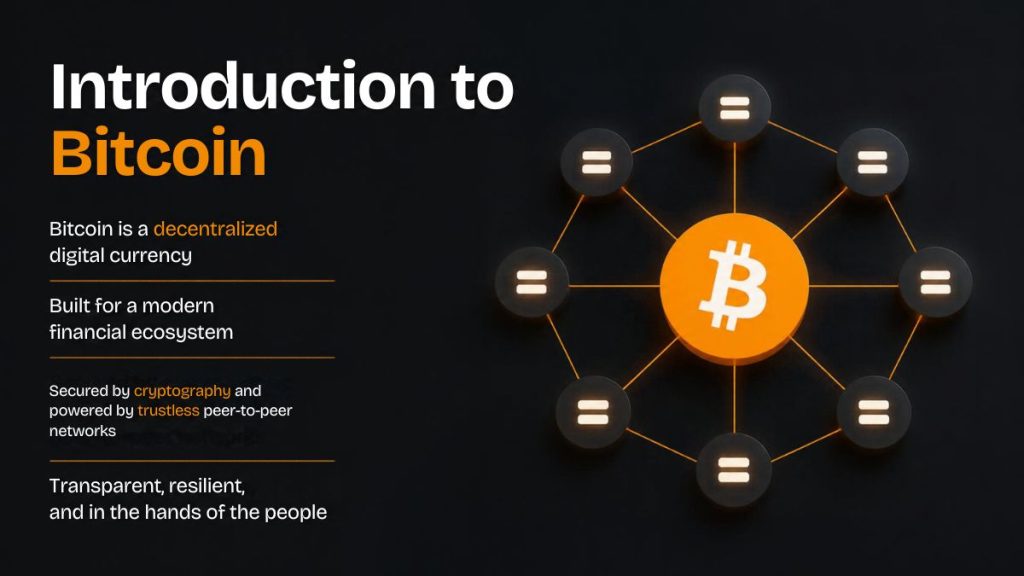
How to buy, mine and use bitcoin for your goals
Most people acquire bitcoin through an exchange. Mining is a separate business decision: you pay for computing equipment and electricity while competing for uncertain rewards. If your goal is to pay someone who accepts bitcoin, buying a small amount is usually simpler than setting up a miner.
Buy a fraction of bitcoin through an exchange
You don’t need enough cash for one whole bitcoin. Each bitcoin contains 100 million smaller units called satoshis, and exchanges generally let you buy a fraction using U.S. dollars.
Choose an exchange available where you live, and review its trading fees, withdrawal charges, identity requirements and payment methods. For example, Coinbase lets eligible customers fund purchases through supported bank and card options. Features and availability vary by location.
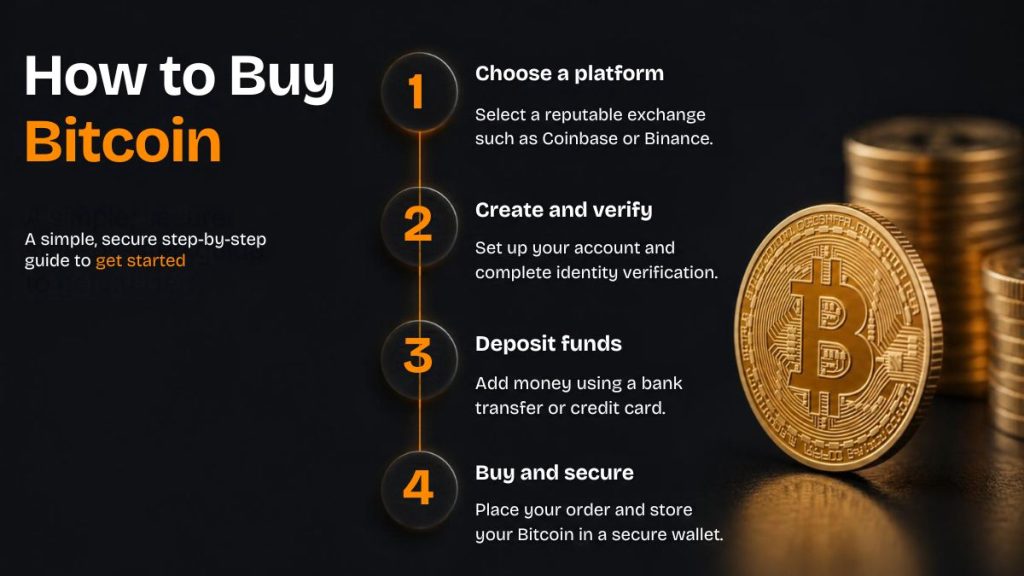
After opening and verifying an account, add a payment method and check the order preview before confirming. Look at the total cost, not only the advertised trading fee. A quoted purchase price may include a spread, and withdrawing bitcoin to your own wallet may carry another charge.
Secure your bitcoin in a wallet you control
A bitcoin wallet doesn’t store coins inside your phone or hardware device. It stores the private keys needed to authorize spending bitcoin recorded on the blockchain.
Leaving bitcoin on an exchange is convenient, especially if you trade often. With a custodial account, however, the provider controls the keys and handles withdrawals. A personal software or hardware wallet gives you direct control, along with full responsibility for backups.
Keep your recovery phrase offline and private. Anyone with it may be able to take your bitcoin, while losing it can leave you unable to access your funds. Before withdrawing, confirm that the destination is a Bitcoin address you control. For a first transfer, consider sending a small test amount.
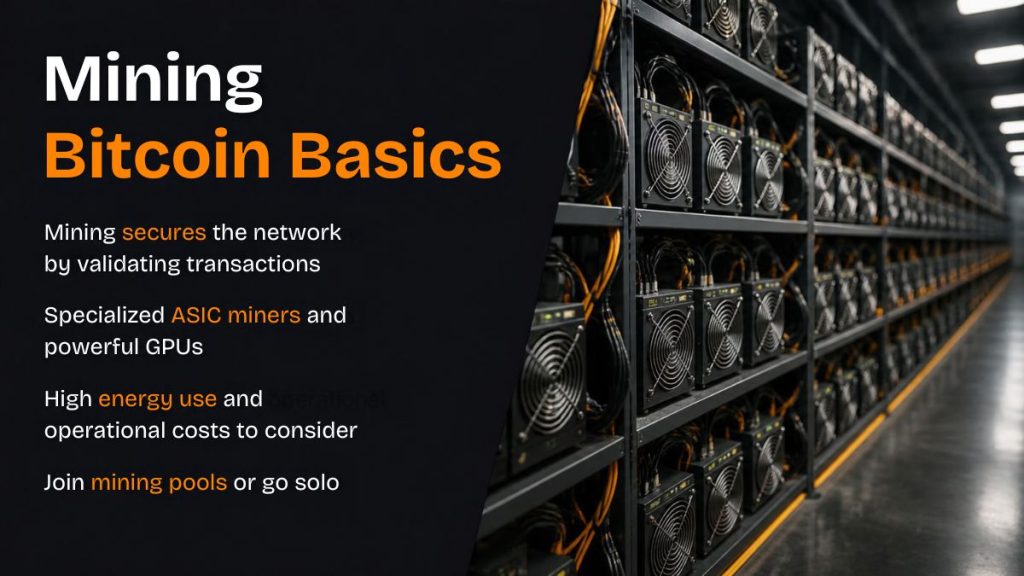
What bitcoin mining takes, and why home mining rarely pays
Mining uses proof-of-work. Specialized machines repeatedly calculate hashes while competing to propose the next block. The miner that finds a valid block can receive newly issued bitcoin plus transaction fees. Independent network nodes check that the block follows Bitcoin’s rules.
That reward isn’t a wage. Results depend on computing power, network difficulty, electricity prices and bitcoin’s market price. A home miner can run equipment for months and still lose money after expenses.
Compare ASIC hardware, power use and cooling costs
Bitcoin mining now depends on application-specific integrated circuit machines, or ASICs. A standard laptop or desktop computer can’t realistically compete with large operations running specialized equipment.
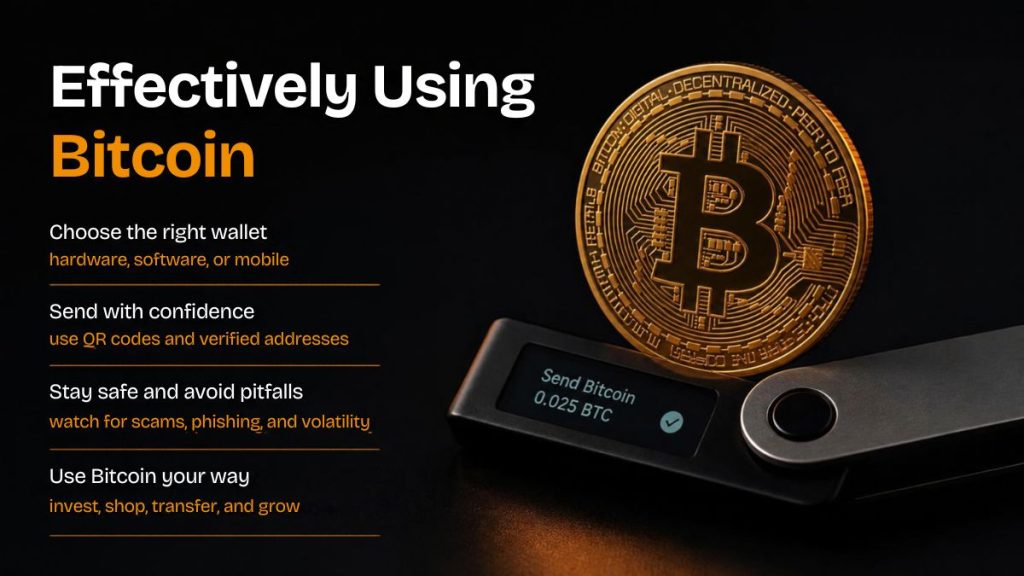
Before buying an ASIC, check its power draw in watts and the price you pay per kilowatt-hour. Then account for cooling, fans, maintenance, internet access and any local rules affecting noise or electrical use. Equipment prices vary, and older used machines may cost less upfront while consuming more power for each unit of computing work.
Run the numbers using cautious assumptions about earnings. Even a newer machine can become unprofitable if mining difficulty rises or bitcoin’s price falls.
Choose a mining pool and understand its payout rules
Mining pools combine participants’ computing power. When a pool earns a block reward, it distributes proceeds according to its payout rules. This can make payments more regular than solo mining, but each participant receives a share rather than the whole reward.
Compare pool fees, minimum withdrawal amounts and payout methods. Also check its operating history and whether its instructions support your equipment. CGMiner and BFGMiner are established mining software names, although compatibility depends on the particular ASIC and setup.
A pool may make payouts steadier, but it can’t turn high electricity costs into a profitable mining operation.
How Bitcoin’s supply affects mining and buying
Bitcoin’s rules limit its eventual supply to 21 million coins. New bitcoin enters circulation through block rewards, which periodically shrink through events called halvings. The April 2024 halving reduced the block subsidy to 3.125 BTC; the next reduction is expected around 2028, subject to when the required block is mined.
The block subsidy is only part of a miner’s potential earnings. Miners can also collect fees attached to transactions in a block. Meanwhile, the network adjusts mining difficulty as computing power changes. More machines joining the competition don’t make blocks arrive proportionally faster or guarantee more bitcoin for any one miner.
Scarcity doesn’t guarantee a higher market price, either. Buyers can pay more or less for the same limited asset as demand changes. When deciding how to buy, mine and use bitcoin, keep the supply schedule separate from any prediction about future returns.
Use bitcoin for payments or long-term holding with care
Spending and holding bitcoin raise different questions. A payment needs a willing recipient and an accurate transfer. An investment needs a plan for custody, price swings and the possibility of a substantial loss. In both cases, transaction fees and local tax treatment matter.
Pay a merchant or transfer bitcoin safely
An online merchant may show a wallet address or payment QR code. A physical store that accepts bitcoin may use a similar QR code at checkout. In your wallet, enter or scan the destination, confirm the amount and review the details before sending.
Check the network as well as the address. A recipient asking for an on-chain Bitcoin payment isn’t necessarily able to receive a Lightning payment or a token on another network. Confirm which method the recipient supports, especially when using an exchange withdrawal screen.
Fees change with network demand, and an on-chain payment may take time to receive confirmations. A merchant can set its own rules for when it considers a payment complete. Confirmed transfers generally can’t be reversed by calling a bank or disputing a card charge.
Balance investment goals with bitcoin’s risks
Bitcoin trades around the clock, and its price can move sharply while you’re asleep. Regulation, investor sentiment and broader economic conditions can all affect demand. There’s no guaranteed value or return.
Custody brings another set of risks. Exchanges can suffer breaches or operational failures; personal wallets can be compromised through phishing or a stolen recovery phrase. Be wary of anyone promising fixed bitcoin returns or pressuring you to transfer funds to an unfamiliar address.
If you’re buying for the long term, choose how much you can afford to lose and research where you’ll keep it. Learn your local tax rules before selling, exchanging or spending bitcoin. Those actions can have tax consequences even if the coins never reach your bank account.
Selling bitcoin and getting money back into your bank
Buying is only half of a plan to use bitcoin. If you expect to convert it into cash later, check the selling and withdrawal process before you deposit funds.
An exchange may let you sell bitcoin for your local currency, then withdraw the proceeds to a linked bank account. Review its supported withdrawal methods, limits, trading fees and expected processing times. The price you receive can differ from the price you saw moments earlier because bitcoin moves quickly and the exchange may charge a spread.
If your bitcoin sits in a personal wallet, you’ll generally need to transfer it to a service that can handle the sale. Verify the deposit address and network before sending. Wait for the required confirmations, then confirm that the deposit appears in your account before placing a sell order.
Keep records of what you paid, what you received and any fees. Those details can help you calculate a gain or loss and explain a transaction if your exchange or bank asks about it.
Check taxes, protections and local rules before acting
The rules around bitcoin depend on where you live and what you do with it. In the United States, the IRS generally treats digital assets as property for federal tax purposes. Selling bitcoin or using it to buy goods can create a taxable gain or loss. Mining rewards may also create taxable income, with further consequences depending on how you mine.
Save transaction dates, amounts, fees and the value in your local currency at the time. Exchange histories can help, but they may not show the full picture if you move coins among wallets or use several services.
Bitcoin holdings don’t receive the same protections as money in an insured bank deposit. FDIC deposit insurance doesn’t cover bitcoin, and SIPC protection doesn’t insure you against a decline in its value. A platform’s separate insurance policy may have narrow terms, so read what it covers rather than assuming every loss qualifies.
Rules also change. The European Union has a dedicated framework called Markets in Crypto-Assets, while U.S. requirements draw on several areas of law. Check the requirements that apply in your location before trading, operating mining equipment or accepting bitcoin as a business.
Choose the path you can manage
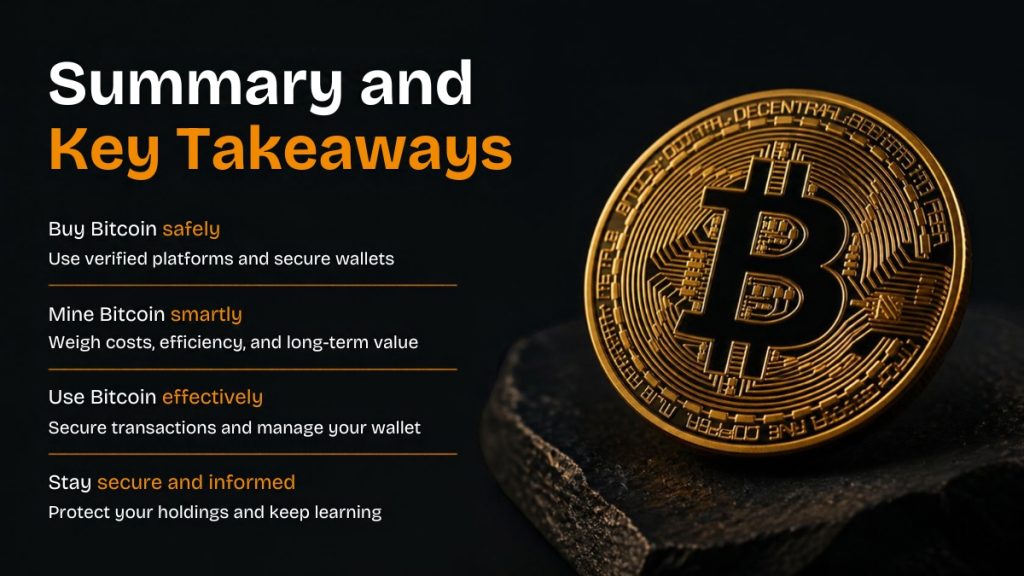
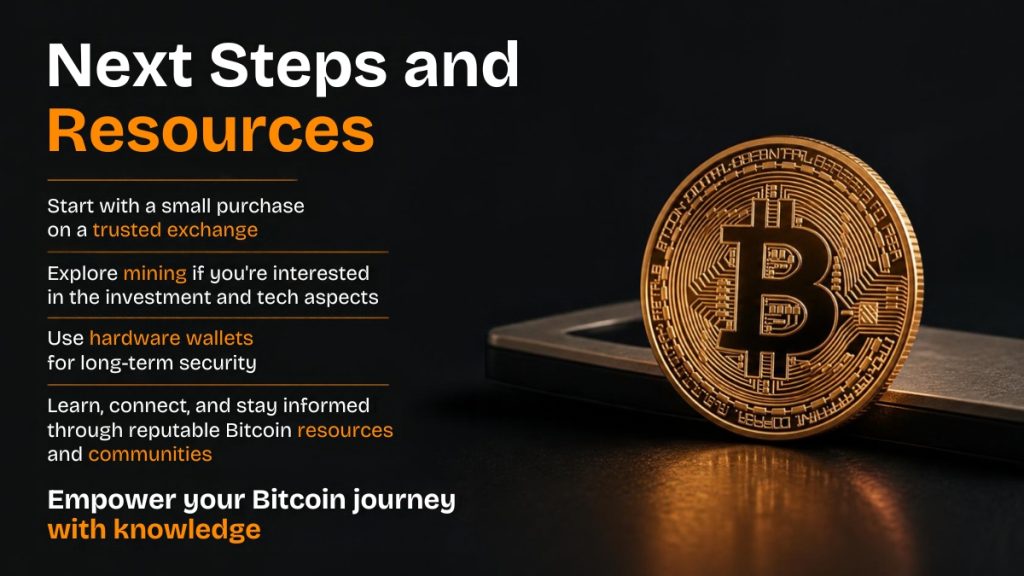
Buying a fraction through an exchange is the simplest way to acquire bitcoin. Mining requires specialized hardware, cheap enough power and a realistic view of uncertain rewards.
Whether you plan to spend bitcoin or hold it, control over your keys and attention to transaction details matter. Research the costs, risks and rules where you live before committing money you can’t afford to lose.