The best forex risk management course depends on who you are, since position size, leverage and drawdown control matter more than entry signals. The article compares five options on cost, depth, format and audience. A1 Trading’s free, self-paced course teaches beginners risk per trade, stop losses and leverage basics.
Udemy’s Ultimate Forex Risk Management course adds the math behind position sizing and drawdown recovery for intermediate retail traders, though its certificate is not accredited. Coursera’s Forex Markets, Pricing and Risk Management approaches currency risk from the finance side, covering forwards and options, but it leans academic. EuroFinance’s Advanced FX Risk Management is instructor-led, employer-priced training for treasury professionals who handle real corporate exposure.
WTI’s Post Graduate Diploma offers the most formal, credential-focused path, but it is overkill for casual traders. Each course has limits, including no personal feedback on trades and no substitute for discipline after a losing streak. Retail traders should start with the free course and add Udemy, while corporate hedgers should choose EuroFinance or Coursera. Finish a course before funding a live account, risk a small fixed percentage per trade, and treat bonus funds as capital to protect.
Best Forex Risk Management Course 5 Top Picks Compared
Most traders who blow an account did not lack a strategy. They lacked a plan for what happens when the strategy is wrong. If you are searching for a forex risk management course, you already see that position size, leverage and drawdown matter more than any entry signal.
Here is the short answer. The best course depends on who you are. A retail trader needs hands-on training in stop losses, risk per trade and leverage limits. A finance professional needs coverage of hedging tools like forwards and options for corporate exposure. Free courses can teach the basics well. Paid and certified programs make sense when you want structure, feedback or a credential.
Below, we compare 5 top picks on cost, depth, format and who each one suits. This matters to us at InstaForex Bonus because bonus funds disappear quickly without risk rules. Strict volume requirements push beginners to overtrade, and a good course teaches you to protect your capital first.
1. A1 Trading free risk management course
What it covers

A1 Trading’s free forex risk management course is a practical introduction to protecting a trading account. It focuses on the habits that keep you in the game rather than on chart patterns. Expect topics like these:
- Risk per trade and position sizing
- Stop loss and take profit placement
- Risk to reward ratios
- Leverage and margin basics
- Drawdown and emotional discipline
Who it is best for
Beginners get the most from it. If you just opened a live account, or you are about to claim a bonus, this is a low-effort way to learn the basics before real money is at stake.
Retail traders who already know what a lot is will also find it useful as a structured refresher on position sizing. Corporate treasurers should skip it, because it is built for individual traders and not for hedging company exposure.
Cost and format
The course is free and self-paced, so you can finish it in one evening or spread it over a week.
| Detail | A1 Trading |
|---|---|
| Price | Free |
| Format | Online, self-paced |
| Level | Beginner |
| Best use | Learning core retail risk rules |
Limitations to know
Depth is the catch. A free course gives you rules, but no feedback on your own trades, and it will not teach you to build a full risk model. There is also no corporate hedging content, so forwards and options are outside its scope.
Finally, no course can enforce discipline. Knowing you should risk 1% per trade means nothing if you ignore it after two losses.
Knowing your risk rules is easy, following them after a losing streak is the real skill.
2. The Ultimate Forex Risk Management Trading Course
What it covers
This Udemy video course has one rule at its core: protect the account first. It shows you how to size every trade from your stop distance.
- Position size formulas
- Risk to reward and expectancy
- Drawdown limits and recovery math
Risk the same small fraction every trade and a losing streak stays survivable.
Who it is best for
Retail traders who have a strategy but keep breaking their own rules get the most value. As a forex risk management course for individuals, it suits intermediate traders who want the math behind sizing.
Beginners can follow along, but A1 Trading is a gentler first step. Finance teams should look elsewhere for hedging.
Cost and format
It is a paid, one-time purchase, and Udemy runs frequent sales, so check the current price first.
| Detail | Ultimate course |
|---|---|
| Format | On-demand video |
| Level | Beginner to intermediate |
| Credential | Completion certificate |
Limitations to know
The certificate is not an accredited credential, so employers will not give it much weight. You also get no personal feedback on your trades.
Corporate hedging tools like forwards and options are outside its scope. Read recent reviews before buying, because content and ratings change.
3. Coursera Forex Markets, Pricing and Risk Management
What it covers

This course approaches currency risk from the finance side. It explains how FX markets work and how prices are set, then shows how exposure is measured and hedged.
- Spot and forward pricing
- Types of currency exposure
- Hedging with forwards and options
Who it is best for
Finance students, analysts and junior treasury staff get the most from it. It is a good bridge into corporate hedging if FX is new to you.
Retail traders can borrow the pricing logic, but it will not teach position sizing for a live account. Start with A1 Trading for that.
Cost and format
Access and certificate pricing vary, so confirm current terms on the course page. A paid certificate is usually optional.
| Detail | Coursera |
|---|---|
| Format | Online, self-paced video |
| Level | Beginner to intermediate |
| Credential | Completion certificate |
Limitations to know
As a forex risk management course, it leans academic. You get no trade-level practice with stop losses or leverage.
Hedging theory only pays off when you can tie it to a real exposure.
The certificate shows completion, not a professional qualification.
4. EuroFinance Advanced FX Risk Management
What it covers
EuroFinance trains corporate treasury professionals, and this program targets real company exposure. It goes past the basics into advanced hedging decisions.
- Transaction, translation and economic exposure
- Hedging with forwards, options and swaps
- Hedge policy and reporting to management
Who it is best for
Treasurers, finance managers and risk analysts who already handle currency flows get the most value. It is the strongest option here for corporate hedging.
Retail traders should skip it. It will not teach stop losses or position sizing, and a retail-focused forex risk management course like A1 Trading fits you better.
Cost and format
Programs are paid and priced for employers, usually as instructor-led training. Confirm current dates and fees with EuroFinance before you plan a budget.
| Detail | EuroFinance |
|---|---|
| Format | Instructor-led training |
| Level | Advanced |
| Best use | Corporate FX hedging |
Limitations to know
Cost is the main barrier, and prior FX knowledge is assumed. Beginners will struggle to keep up.
Nothing here covers leverage or drawdown for individual accounts.
Advanced hedging training pays off only when you have real exposure to hedge.
5. WTI Post Graduate Diploma in Forex and Risk Management
What it covers
As a forex risk management course, this is the heaviest and most formal option on the list. It treats currency risk as a full discipline, not a single skill, and it aims at diploma-level depth.
- Forex market structure and pricing
- Exposure measurement and hedging
- Risk frameworks and controls
Who it is best for
Career changers and finance graduates who want a recognized credential get the most value. It also suits professionals moving into treasury or risk roles.
Casual retail traders will find it more than they need. A free course covers position sizing and stop losses for far less time and money.
Cost and format
Expect a paid, long-form program, delivered online or in a classroom depending on the provider. Confirm current fees, duration and accreditation with WTI before you enroll.
| Detail | WTI Diploma |
|---|---|
| Format | Structured diploma program |
| Level | Postgraduate |
| Credential | Diploma |
Limitations to know
Time and cost are the main hurdles. A diploma is overkill for a trader who only needs stop loss rules, and its value depends on whether employers in your market recognize the credential.
You also get little of the day-to-day practice a retail account needs, such as sizing trades around a bonus balance.
A diploma proves you studied risk, not that you manage it well.
Choosing the course that fits your goals
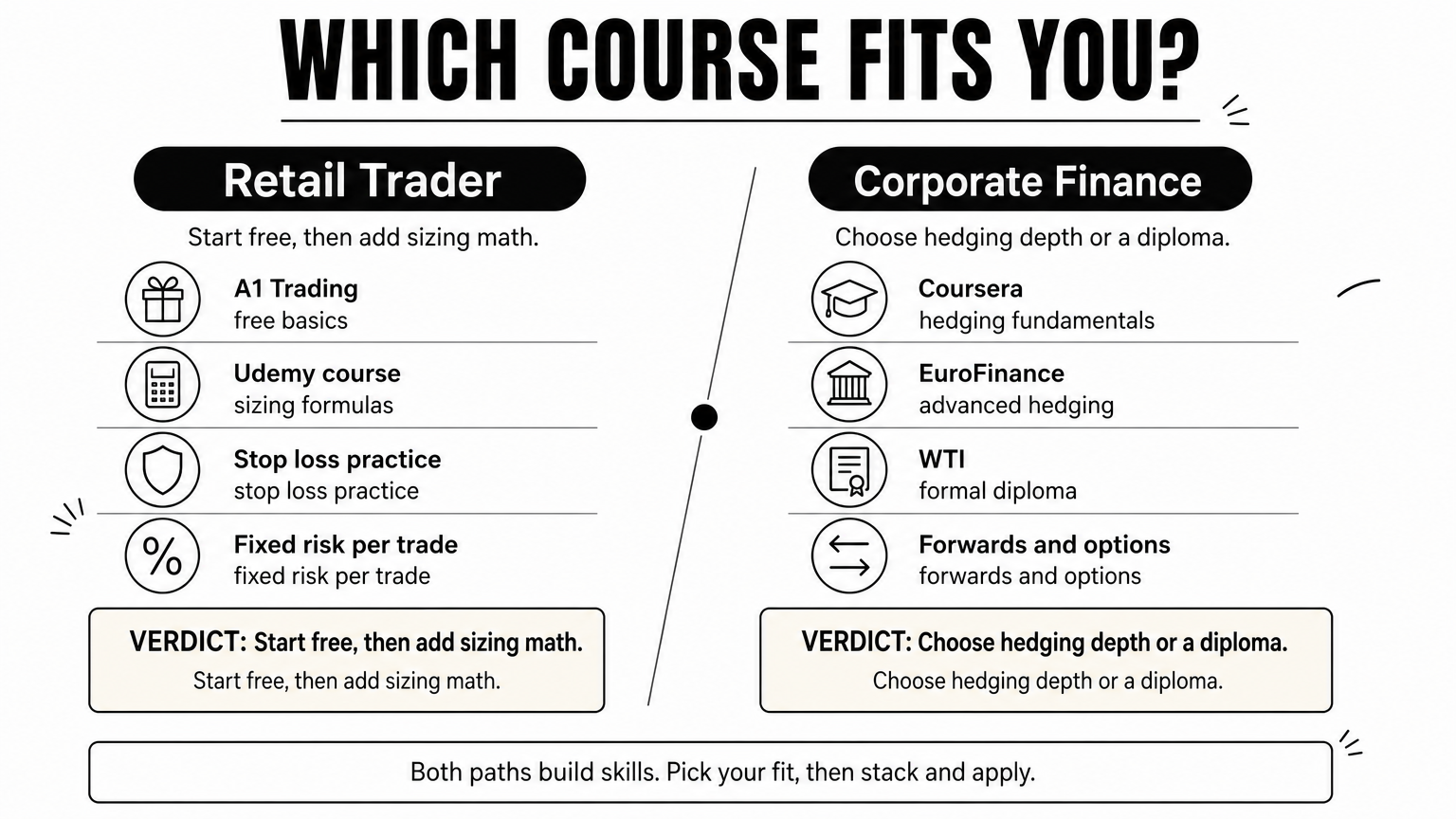
The right forex risk management course depends on your job, not the price tag. If you trade your own money, start with A1 Trading for free, then add the Udemy course when you want the sizing math. If you hedge company exposure, EuroFinance or Coursera fit better, and WTI makes sense when you need a formal diploma.
Whatever you pick, finish it before you fund a live account. Then apply one rule right away: risk a small, fixed percentage on every trade. A course only works if you follow its rules after a losing streak.
Ready to put those rules to work? Read the terms on every offer, size your trades around the volume requirements, and see how InstaForex bonus offers work before you claim one. Treat the bonus as a tool, and protect it like your own capital.