Choosing a forex broker in Canada starts with regulation: the best options are registered with CIRO, which oversees dealers under provincial rules and caps retail leverage near 1:50, far below offshore offers. The article ranks eight picks, scored on verified registration, trading costs, account terms, platforms, funding and support, while ignoring bonuses and headline leverage.
Interactive Brokers offers the lowest raw costs for larger trades but lacks MetaTrader. FOREX.com suits beginners with MT4, MT5 and TradingView. CMC Markets stands out for charting and pattern tools, OANDA Canada for tiny position sizes and no minimum deposit, Plus500 for a simple app, AvaTrade for fixed spreads and MT5, and Questrade for existing clients using MT4.
A comparison table and quick picks match brokers to trader styles, and a cost example shows spread-only pricing favors small trades while raw spreads favor larger ones. Readers learn to verify the legal entity on CIRO’s registry, prepare ID and proof of address, start with a demo and small deposit, and test an early withdrawal. Forex is legal in Canada through registered dealers, and the CRA taxes profits as business income or capital gains.
Best Forex Brokers in Canada 8 CIRO-Regulated Picks
Picking a broker in Canada is harder than it looks. Provincial rules are strict, many offshore brokers refuse Canadian clients, and some that accept you operate with no local oversight. If you want the best forex brokers in Canada, start with regulation, then compare costs and platforms.
The short answer: choose a broker that is registered with CIRO (the Canadian Investment Regulatory Organization), which oversees dealers and protects client accounts under Canadian rules. Among the best Canadian forex brokers, CIRO membership matters more than a flashy bonus. Expect lower leverage than offshore firms offer, often capped at around 1:50 for retail accounts, in exchange for stronger safeguards.
Below, you’ll find 8 CIRO-regulated picks ranked for Canadian traders. For each one, we cover spreads and commissions, account minimums, available platforms such as MT4 and cTrader, and the trust factors that count when you fund an account. At FXNDB, we review brokers daily, so we focus on terms you can verify, not marketing claims.
1. How we chose these CIRO-regulated forex brokers
Every broker on this list had to pass one gate before we compared anything else: legal standing in Canada. After that, we scored cost, platforms, and track record. The goal is simple. You should be able to trust the ranking method as much as the names on it.
Regulation comes first
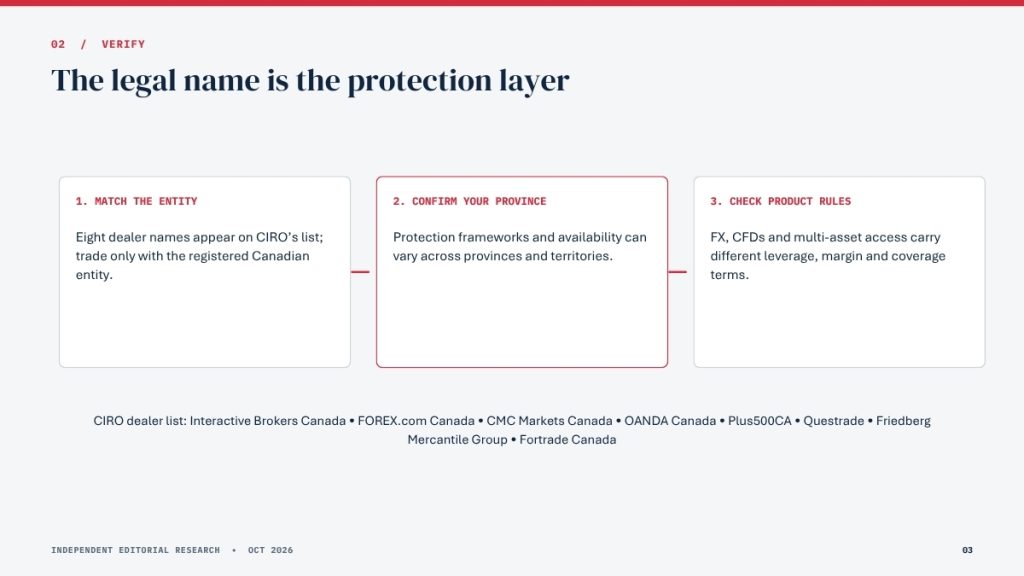
Each pick must be a CIRO-member dealer that accepts Canadian residents through a Canadian entity. We checked each firm against the public registry on CIRO’s website rather than trusting the badge on a broker’s homepage. Many global brands hold licenses elsewhere, and that does not make them a regulated forex broker in Canada.
Client protection also factored in. We looked at segregated client funds and the Canadian Investor Protection Fund (CIPF) coverage that applies to some accounts. Where a product is not CIPF-covered, we say so in that broker’s review.
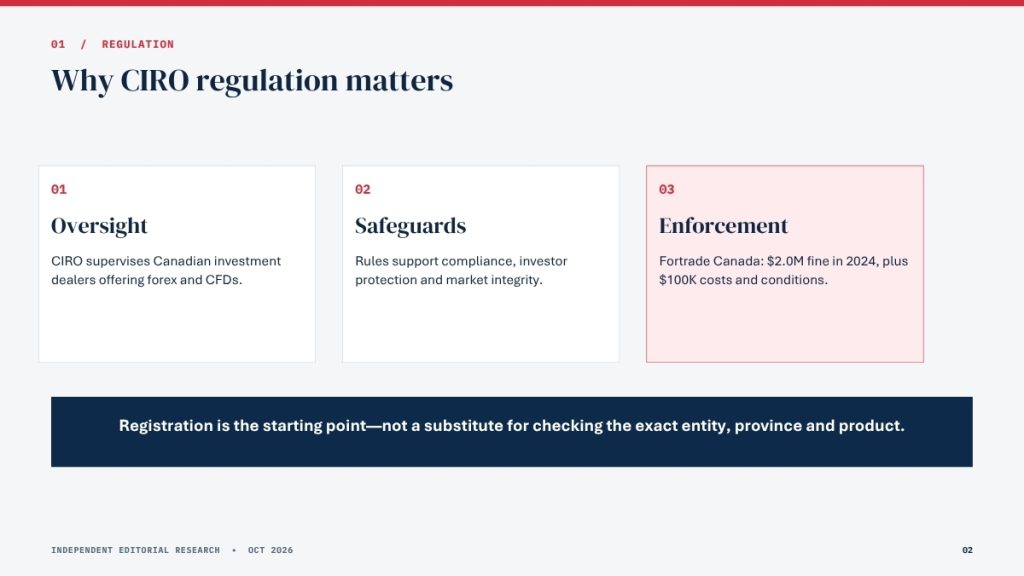
If a broker is not registered with CIRO for Canadian clients, it does not make this list, no matter how tight its spreads look.
What we scored
Among the best brokers for forex in Canada, the real differences show up in cost and tools. We compared the same items for every broker so the numbers line up.
| Criterion | What we checked |
|---|---|
| Trading costs | Typical EUR/USD spread, commissions, overnight financing |
| Account terms | Minimum deposit, base currency (CAD support), leverage limits |
| Platforms | MT4, MT5, cTrader, proprietary web and mobile apps |
| Funding | Interac, EFT, wire, card options and withdrawal speed |
| Fees outside trading | Inactivity, deposit, and withdrawal charges |
| Support and research | Canadian-hours support, market analysis, education |
What we ignored
We gave no weight to forex broker welcome bonuses. Canadian rules limit what regulated dealers can offer, and a bonus tied to heavy trading volume rarely helps a beginner. We also ignored headline leverage, because Canadian retail accounts face caps that make the number nearly identical across regulated firms.
Finally, a note on how FXNDB earns money. We receive referral commissions from some brokers, and that is why we explain our process in detail. Payout size did not set the order. Where a broker has a clear weakness, such as a higher spread or a limited platform choice, we state it plainly.
2. Interactive Brokers
Overview and CIRO regulation
Interactive Brokers Canada Inc. is a CIRO-regulated dealer and a CIPF member, so it clears the first gate on our list easily. It is the Canadian arm of a global, US-listed firm. Forex is one product inside a full brokerage account, next to stocks, options, and futures. CIPF covers eligible securities and cash if the firm fails, but it does not cover trading losses.
Spreads, commissions, and fees
Pricing is where IBKR stands out among the best brokers for forex in Canada. You pay a tight raw spread plus a small commission, which is how institutional desks price trades. Small orders hit the per-order minimum, so micro-lot trading costs more than the headline rate suggests.
| Cost item | Typical figure |
|---|---|
| EUR/USD spread | About 0.1 to 0.2 pips |
| Commission | 0.2 basis points of trade value |
| Minimum per order | Around US$2 |
| Account minimum | None for most account types |
Interactive Brokers gives you some of the lowest forex costs available to Canadians, but only if you trade in size.
Figures change, so confirm the current schedule on the broker’s site before you fund.
Platforms and tools
You get Trader Workstation (TWS), the newer IBKR Desktop, the GlobalTrader mobile app, and a web-based Client Portal. TWS is powerful, with deep order types, built-in risk tools, and an API for Python or Java automation. You will not find MT4, MT5, or cTrader here. If your strategy lives in an MT4 expert advisor, look elsewhere.
Who it suits and drawbacks
Serious, cost-focused traders get the most from IBKR. That includes active traders, algorithmic traders, and anyone who wants forex, stocks, and options in one account. Beginners often struggle. The interface is dense, and support runs mostly through tickets and phone queues rather than quick chat. Canadian leverage caps also apply, so do not expect offshore-style margin.
3. FOREX.com
Overview and CIRO regulation
FOREX.com is the retail brand of StoneX, a US-listed financial group, and it is built around currencies far more than IBKR is. It is a forex-first broker with a long record serving retail traders.
Canadian clients are served through a CIRO-regulated Canadian entity. Confirm the exact legal name on the CIRO registry before you deposit, because the firm’s global sites run on different entities. Leverage is capped under Canadian rules, so expect around 1:50 on major pairs.
Spreads, commissions, and fees
Pricing comes in two forms. A standard account builds the cost into the spread, while a commission account offers tighter raw spreads plus a fee per trade.
| Cost item | Typical figure |
|---|---|
| EUR/USD spread (standard) | About 1.0 to 1.4 pips |
| EUR/USD spread (commission account) | From about 0.2 pips plus commission |
| Inactivity fee | Applies after extended dormancy |
FOREX.com is a strong all-round pick, but its standard spreads cost more than IBKR’s raw pricing.
Schedules change, so check current rates and the minimum deposit on the broker’s site.
Platforms and tools
Platform choice is the main edge over IBKR. You can trade on:
- MetaTrader 4 and MetaTrader 5, including expert advisors
- TradingView charting connected to your account
- The proprietary web platform and mobile app
Research is another strength, with daily market analysis and economic calendars built into the platforms.
Who it suits and drawbacks
Beginners and intermediate traders get the most from FOREX.com. You can start on a familiar MetaTrader setup, then move to raw pricing as your volume grows. The education library also helps if you are still learning.
Drawbacks are modest. Standard-account spreads run wider than raw-pricing rivals, and an inactivity fee can eat into a dormant balance. Active scalpers should compare the commission account carefully.
4. CMC Markets
Overview and CIRO regulation
CMC Markets Canada Inc. is a CIRO-regulated dealer and a CIPF member, which makes it a dependable regulated forex broker in Canada. It is the local arm of a London-listed group founded in 1989. Canadian clients trade currency CFDs, and the group is known for tight pricing on major pairs. Check the exact entity on CIRO’s registry before you deposit.
Spreads, commissions, and fees
Costs sit inside the spread, so standard forex trades carry no separate commission. That keeps pricing simple, and it suits traders who dislike per-trade math.
| Cost item | Typical figure |
|---|---|
| EUR/USD spread | From about 0.7 pips |
| Commission | None on standard accounts |
| Overnight financing | Charged on positions held past rollover |
CMC Markets beats most spread-only brokers on price, but raw-pricing accounts still cost less for high-volume traders.
Rates change, so confirm the current minimum deposit and spreads on the broker’s site.
Platforms and tools
The star here is the Next Generation web platform. It offers a deep indicator library, many chart types, and a pattern recognition scanner that flags setups for you. A mobile app mirrors the core tools. Availability of MT4 differs by region, so confirm it is offered to Canadian accounts before you build a plan around expert advisors.
Who it suits and drawbacks
Active technical traders get the most from CMC Markets. If you trade off charts and patterns, the analysis tools justify the spread. Intermediate traders who want one clean platform will also feel at home.
Drawbacks are real. You will not find cTrader or MT5, and the product range for Canadians is narrower than the global site shows. Raw-spread seekers should look at IBKR instead.
5. OANDA Canada
Overview and CIRO regulation
OANDA (Canada) Corporation ULC is a CIRO-regulated dealer based in Toronto, and it ranks among the longest-running best Canadian forex brokers. The parent group dates to 1996. Check the exact entity on CIRO’s registry before you deposit. Forex and CFD accounts are generally not covered by CIPF, so confirm how client funds are held.
Spreads, commissions, and fees
Pricing is spread-based, with no commission on standard accounts. The real draw is size flexibility, since you can trade very small positions and scale up slowly.
| Cost item | Typical figure |
|---|---|
| EUR/USD spread | About 1.0 to 1.4 pips |
| Commission | None on standard accounts |
| Minimum deposit | None for most accounts |
| Minimum trade size | 1 unit |
OANDA’s edge is flexible position sizing for small accounts, not the lowest spreads in Canada.
Confirm current spreads and any rebate programs on the broker’s site, since both change.
Platforms and tools
You can trade on the fxTrade web platform, its mobile app, MetaTrader 4, and TradingView. Charting is clean, and the REST API lets coders build automated strategies. You will not find cTrader or MT5 here, so check platform support if you rely on either.
Who it suits and drawbacks
Beginners and small-account traders get the most from OANDA. With no minimum deposit and tiny trade sizes, you can test a strategy with real money at very low risk. Developers also like the API.
Drawbacks are modest. Standard spreads run wider than IBKR’s raw pricing, the product range is narrower than a full brokerage, and high-volume traders will want to compare commission-based rivals.
6. Plus500
Overview and CIRO regulation
Plus500 is a London-listed group that built its name on a simple CFD app. Canadian clients trade through a Canadian entity that should appear on CIRO’s registry, so confirm the exact legal name before you deposit. Plus500 is a CFD-focused product, so assume it is not covered by CIPF and treat your margin as capital at risk. That makes it a regulated forex broker in Canada, but with narrower safeguards than a full brokerage.
Spreads, commissions, and fees
Plus500 charges no commission. Your cost is the spread, plus financing on positions held overnight. That keeps pricing easy to read, though spreads sit above raw-pricing accounts.
| Cost item | Typical figure |
|---|---|
| EUR/USD spread | About 0.8 to 1.3 pips |
| Commission | None |
| Overnight financing | Charged on positions held past rollover |
| Inactivity fee | Applies after a period of dormancy |
Plus500 is easy to start with and gets pricier as your volume grows.
Confirm the current minimum deposit and fee schedule on the broker’s site.
Platforms and tools
You get one proprietary platform, offered as a web version and a mobile app. There is no MT4, MT5, or cTrader. Tools include:
- Price alerts and basic risk-management controls
- Stop-loss and take-profit orders
- A demo account to practice first
Guaranteed stops may be offered, so check availability for Canadian accounts.
Who it suits and drawbacks
New traders who want a clean, simple app get the most from Plus500. You can open a demo, place a trade in seconds, and skip platform setup entirely.
Experienced traders will hit limits fast. No expert advisors, thin research, and wider spreads make it a poor fit for scalpers or anyone who automates. Look at FOREX.com or IBKR instead.
7. AvaTrade
Overview and CIRO regulation
AvaTrade is a Dublin-based group founded in 2006 that serves clients in many countries. Canadian accounts run through a Canadian entity that should appear on CIRO’s registry, so verify the exact legal name before you deposit. Treat CFD margin as capital at risk, and do not assume CIPF coverage.
Spreads, commissions, and fees
AvaTrade leans on fixed spreads with no commission on standard accounts. Your costs stay predictable during news events, though the fixed figure sits above raw pricing.
| Cost item | Typical figure |
|---|---|
| EUR/USD spread | Fixed, about 0.9 pips |
| Commission | None |
| Inactivity fee | Applies after about three months without trading |
AvaTrade’s fixed spreads make your costs predictable, not cheap.
Confirm the current minimum deposit and fee schedule, along with any AvaTrade welcome deposit bonus, on the broker’s site.
Platforms and tools
Choice is the strength here, and it is wider than at most rivals on this list:
- MT4 and MT5, including expert advisors
- The AvaTradeGO mobile app and a web platform
- Copy-trading options, if offered to Canadian accounts
AvaTrade also markets a risk tool called AvaProtect, so check whether it is available to you and what it costs.
Who it suits and drawbacks
MetaTrader users who want fixed pricing get the most from AvaTrade. If you run automated strategies or like copying other traders, it fits well. Beginners also benefit from the demo account and education library.
Drawbacks are clear. Spreads run wider than raw-pricing accounts, inactivity fees apply, and high-volume traders will pay more than at IBKR.
8. Questrade
Overview and CIRO regulation
Questrade is a Toronto-based discount brokerage founded in 1999, and Questrade Inc. is a CIRO-regulated dealer and CIPF member. Few names on this list are as Canadian as this one.
Forex comes through its FX and CFD offering, which is separate from the stock accounts most Canadians know. CIPF covers eligible securities, but assume CFD positions are not covered and confirm the details on CIRO’s registry.
Spreads, commissions, and fees
Pricing is spread-based, so you pay no separate commission on standard trades. Spreads sit in the mid-range, not at raw-pricing levels.
| Cost item | Typical figure |
|---|---|
| EUR/USD spread | About 1.0 to 1.5 pips |
| Commission | None on standard accounts |
| Overnight financing | Charged past rollover |
Questrade’s forex edge is a trusted Canadian name, not rock-bottom spreads.
Check the current minimum deposit and fee schedule on the broker’s site before you fund.
Platforms and tools
Questrade’s FX and CFD accounts are built around MetaTrader 4, so the setup is familiar if you have traded elsewhere. Confirm the platform for your account type, since its stock platforms do not handle forex.
- MT4 on desktop, web, and mobile
- Expert advisors and custom indicators
- No cTrader or MT5
Who it suits and drawbacks
Canadians who already invest with Questrade get the most from it. You can add a small forex account with a familiar local brand and use MT4 without learning a new system.
Drawbacks are plain. Spreads run wider than IBKR’s raw pricing, research is lighter than at FOREX.com, and the platform choice is narrower than AvaTrade’s. Active scalpers should look elsewhere.
9. Side-by-side comparison of Canadian forex brokers
Costs and platforms at a glance
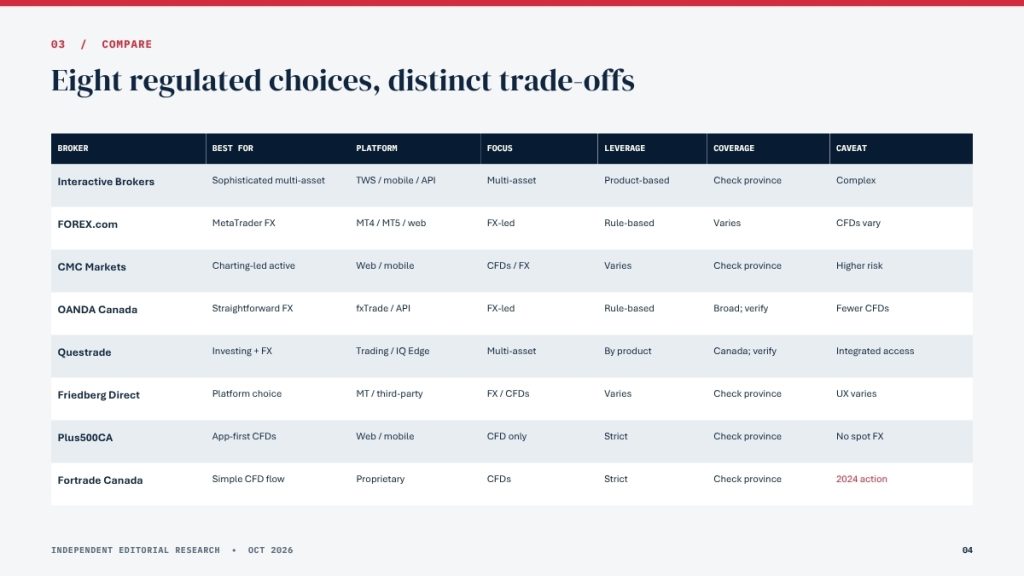
Here is how the best forex brokers in Canada compare on the numbers that matter most, scored the same way as our top forex brokers list for 2026. Spreads are the typical EUR/USD figures from the reviews above, and they move with market conditions, so confirm live pricing on each broker’s site before you fund.
| Broker | EUR/USD spread | Commission | Platforms |
|---|---|---|---|
| Interactive Brokers | 0.1 to 0.2 pips | 0.2 bps, about US$2 minimum | TWS, IBKR Desktop, API |
| FOREX.com | 1.0 to 1.4 pips | None (standard) | MT4, MT5, TradingView |
| CMC Markets | From 0.7 pips | None | Next Generation |
| OANDA Canada | 1.0 to 1.4 pips | None | fxTrade, MT4, TradingView |
| Plus500 | 0.8 to 1.3 pips | None | Proprietary app |
| AvaTrade | Fixed, about 0.9 pips | None | MT4, MT5, AvaTradeGO |
| Questrade | 1.0 to 1.5 pips | None | MT4 |
Choose on cost if you trade in size, and choose on platform if you automate.
Which broker fits which trader
Matching a broker to your style beats chasing the single lowest spread. These are our quick picks, based on the reviews above and the trade-offs each one makes.
- Lowest costs: Interactive Brokers
- MetaTrader plus TradingView: FOREX.com
- Charting and pattern tools: CMC Markets
- Small accounts: OANDA Canada
- Simplest app: Plus500
- Fixed spreads and MT5: AvaTrade
- Existing Questrade clients: Questrade
10. How forex regulation works in Canada
Who oversees forex dealers
Canada has no single national securities regulator. Provincial and territorial commissions, such as the Ontario Securities Commission and Quebec’s AMF, write the rules and register firms. CIRO sits beneath them as the self-regulatory organization for investment dealers, formed in 2023 when IIROC and the MFDA merged.
In practice, a regulated forex broker in Canada must be registered as a dealer in your province. Most firms on our list are also CIRO members, which means they follow CIRO’s capital, margin, and conduct rules and face discipline if they break them. That is why the best forex brokers in Canada look similar on leverage and client protection.
A license from another country does not make a broker legal for you. Registration in your province does.
What the rules mean for you
Margin limits are the part you feel first. Retail leverage on major currency pairs is capped near 1:50, far below the 1:500 or higher that offshore brokers advertise. Lower leverage cuts your upside, but it also slows the speed at which a bad trade empties your account.
Before you deposit, verify the firm yourself. Offshore brands often use near-identical names for their Canadian and international entities, so the exact legal name matters.
- Find the broker’s legal entity name in the footer of its Canadian site.
- Search that name on CIRO’s website and confirm it is a current member.
- Check your province’s registration search to confirm the firm is registered to deal with residents.
If any step fails, walk away. Regulation does not protect you from trading losses, but it does give you a place to file a complaint.
11. How to choose a forex broker in Canada
Match the cost model to your trade size
Start with how you trade, because the cheapest broker depends on your volume. A 10,000-unit EUR/USD trade (0.1 lot) is worth about US$1 per pip. Here is how a 1.2-pip spread-only quote compares with raw pricing like IBKR’s, using a 0.15-pip spread and the US$2 minimum order:
| Trade size | Spread-only (1.2 pips) | Raw spread plus commission |
|---|---|---|
| 10,000 units | About US$1.20 | About US$2.15 |
| 100,000 units | About US$12 | About US$3.50 |
Pick the cost model that fits your trade size, not the lowest advertised spread.
Small accounts usually do better with spread-only pricing, while larger, frequent trades favor raw spreads. These figures are illustrative, so rerun the math with live quotes.
Check the practical details
Once costs fit, narrow the field by platform. If you run expert advisors, you need MT4 or MT5, which rules out IBKR and Plus500. Then test what is left before you commit real money:
- Confirm CAD base currency and Interac or EFT funding, so you avoid conversion fees.
- Open a demo and watch fills and slippage during a news release.
- Deposit a small amount, then request a withdrawal before you scale up.
- Contact support during Canadian hours and note how fast you get a real answer.
Apply these steps to the best forex brokers in Canada above and you will usually land on two finalists. Trust the withdrawal test most, since a broker that pays out quickly on a small request is likely to do the same on a large one.
12. How to open a forex account in Canada
What to have ready
Every regulated dealer on this list runs the same know-your-client check, so a little prep saves time. Gather your government-issued photo ID and a proof of address before you start, and the application usually takes about 15 minutes. Expect to provide:
- A passport or driver’s license
- A utility bill or bank statement dated within the last three months
- Your Social Insurance Number, which brokers often request for tax reporting
- Employment, income, and trading experience details for the suitability questionnaire
Steps from application to first trade
Follow these steps in order. Do not skip the first one.
- Verify the entity. Search the exact legal name on CIRO’s registry, as covered above.
- Choose your account type, either spread-only or commission-based, and set CAD as your base currency.
- Complete the application, including the risk questionnaire. Answer honestly, because the broker uses it to decide which products you can trade.
- Upload your ID and address proof. Approval can take minutes or a few business days.
- Fund the account by Interac or EFT, starting with a small amount.
- Practice on a demo, then place your first trade with a stop-loss attached.
Verify the entity before you upload a single document.
Start small and treat the first month as testing. Opening an account with a regulated forex broker in Canada costs nothing, so you can compare two finalists side by side, and newcomers can also read our rankings of the safest brokers for new traders. Request a small withdrawal early, and keep your trade size low until fills and support match what the broker promised.
13. Forex taxes and legality in Canada
Is forex trading legal in Canada?
Yes. Trading forex is legal for Canadian residents when you use a dealer registered in your province, which is why every broker above is CIRO-regulated. The risk sits with unregistered offshore firms, not with the activity itself, which is why we also track the safest forex brokers worldwide.
Avoid any broker that solicits Canadians without registration. If something goes wrong, you may have no complaint route and no recourse under Canadian rules.
How the CRA taxes forex profits
The Canada Revenue Agency treats your gains as either business income or capital gains, and the label decides your bill. No single rule applies. The CRA looks at how often you trade, how long you hold positions, and why you trade.
How often and why you trade decides how you are taxed, not which broker you use.
| Treatment | Taxable portion | Losses | Typical trader |
|---|---|---|---|
| Business income | 100% of profit | Deductible against other income | Frequent, full-time traders |
| Capital gains | 50% of gain | Offset only against capital gains | Occasional, longer-term traders |
Keep a record of every trade, because you must report results in Canadian dollars and hold your records for six years. Convert using Bank of Canada exchange rates, and download your broker’s annual statements. The Canada Revenue Agency publishes current guidance. Tax rules change and your situation is personal, so confirm your treatment with an accountant before you file.
Picking the right broker for you
The best forex brokers in Canada share one trait: CIRO registration that you can verify yourself. Past that gate, the choice comes down to how you trade. Interactive Brokers wins on cost for larger trades, FOREX.com and AvaTrade suit MetaTrader users, OANDA fits small accounts, and Questrade works if you already invest there.
Start with a demo account and a small deposit. Test fills, then request a withdrawal early before you scale up. Leverage will be lower than offshore ads promise, and that is a fair price for protection you can actually use. Keep clean records for tax time, too.
Ready to compare more options? Browse our full list of forex brokers with current reviews and offers, then check any name you like against CIRO’s registry before you deposit a dollar.